






Tank Water Heaters
40-80 Gallon Options · Gas & Propane · Clean Professional Installation
Our Approach to Tank Water Heaters
How a Tank Water Heater Works
- Cold inlet — the dip tube carries it to the tank bottom
- Burner — heats water at the bottom of the tank
- Anode rod — sacrificial rod that fights corrosion
- T&P valve — releases pressure if it builds too high
- Hot outlet — draws the hottest water from the top
Traditional tank water heaters remain a reliable and cost-effective choice for many homes. J&R Mechanical Services installs and replaces tank water heaters with clean, professional workmanship and attention to code compliance.
We install natural gas and propane tank water heaters in sizes from 40 to 80 gallons. We help you determine the right size based on your household water usage, number of bathrooms, and daily hot water needs. Not sure if a tank or tankless water heater is right for you? We can help you decide.
Modern tank water heaters are significantly more efficient than older models. Upgraded insulation, improved burner designs, and electronic ignition systems all contribute to lower operating costs and faster recovery times.
Our installation includes removal of your old unit, proper placement and leveling, all plumbing and gas connections, temperature and pressure relief valve installation, and thorough testing. We handle everything from start to finish.
What Size Water Heater Does Your Home Need?
Sizing is where most water heater regrets start. Too small and the third shower of the morning runs cold; too large and you pay to keep water hot that you never use. The right size depends on your peak-hour demand — how much hot water your household uses in its busiest single hour. As a rough guide, a 40-gallon tank suits one to two people, 50 gallons fits a family of three or four, and larger households or homes with soaking tubs often need 60 to 80 gallons. Fuel type matters too: propane units recover faster than natural gas, so tank size needs vary by fuel type as well as household size.
We size your replacement from how your household actually lives, not from whatever happens to be on the truck. Our plumbers are not paid on commission, so the recommendation you get is the size you need — nothing bigger.
When Should You Replace a Tank Water Heater Instead of Repairing It?
Tank water heaters typically last about ten to twelve years. If yours is leaking from the tank itself, that is the end — the inner tank has corroded through and no repair can fix it. Short of a tank leak, the math is simple: when a repair costs more than half the price of a new unit on an older heater, replacement is usually the smarter spend. Rusty hot water, rumbling or popping sounds from sediment buildup, and steadily longer recovery times are all signs the tank is near the end.
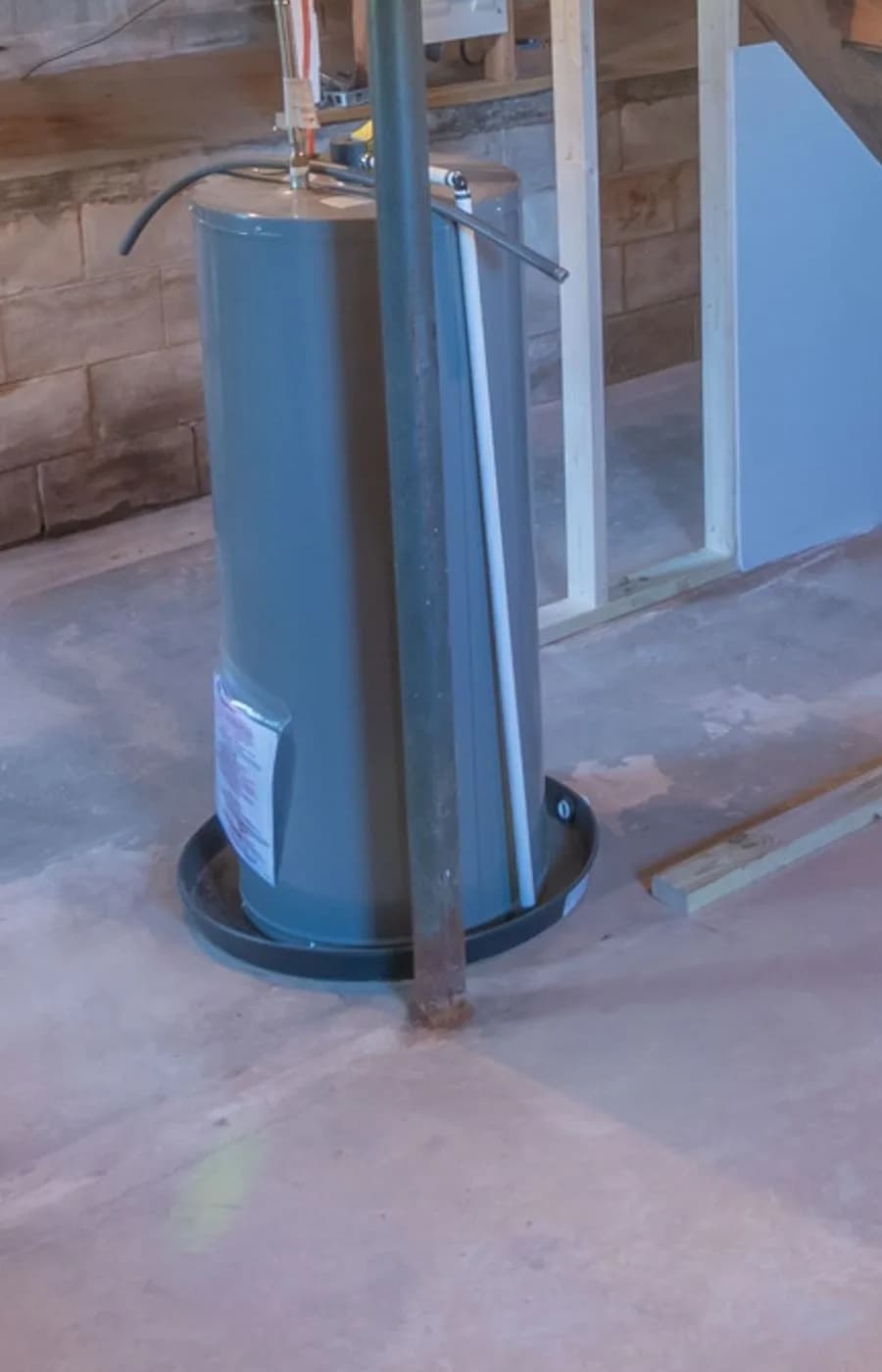
Replacing proactively also lets you schedule the work on your terms instead of taking a cold-shower emergency — and if your old unit is in a finished basement, it avoids a failure flood. If a repair genuinely makes sense, our water heater repair service will tell you so.

Efficiency Maine
Rebates & Guidance
- By the numbers
Electric tank water heaters cost the most to run
Efficiency Maine calls electric-resistance tank water heaters the most expensive common option to run, mainly due to higher electricity costs and shorter typical warranties.
Source: Efficiency Maine - Rebate
$1,150 off a heat pump water heater
Efficiency Maine offers a $1,150 instant discount at participating retailers (or a mail-in rebate) on a qualifying heat pump water heater.
Source: Efficiency Maine - Recommendation
Fuel choice changes the math
Per Efficiency Maine's comparison, gas-fired tank water heaters cost less to run on natural gas than on propane, so it's worth checking both fuel and equipment options before replacing a tank unit.
Source: Efficiency Maine
Program details as of Sep 26, 2026. Rebate amounts and eligibility change; confirm current terms at efficiencymaine.com.
Tank Water Heater Sizing, Parts, and Safety
A tank water heater looks simple from the outside, but sizing it correctly and keeping a few internal parts in good shape separate ten quiet years from a service call every winter. This guide covers what is printed on the yellow EnergyGuide label, what the magnesium rod inside the tank does, what a closed plumbing system needs, and why well water in Kennebec and Cumberland counties asks more of a tank than city water does.
None of this replaces a hands-on inspection. It is meant to help you understand what a technician checks during a service visit, and what is worth asking about first.
Sizing by First-Hour Rating, Not Just Tank Volume
DOE's federal test procedure for water heaters sorts household hot water use into four standard tiers, based on gallons used per day. Every new unit's yellow EnergyGuide label reports an estimated annual energy cost built on one of these tiers, along with its rated capacity in gallons.
That same label also carries a First Hour Rating: how much hot water the unit can deliver during one demanding hour, not just how many gallons the tank holds. Two 50-gallon tanks can post different ratings depending on burner or element size and recovery speed.
ENERGY STAR's buying guidance recommends starting from the gallon capacity of the unit being replaced, then sizing up if the household has grown or added a fixture that pulls hot water at the same time as everything else, such as a second shower or a soaking tub. A contractor can weigh in on whether that calls for a larger tank.
On heat pump water heaters, federal guidance notes that running in the most efficient mode slows recovery time and lowers the First Hour Rating. That matters in a household used to back-to-back showers, since most models include a faster electric-resistance mode for that reason.
| Usage tier | Daily hot water use |
|---|---|
| Very small | about 10 gallons/day |
| Low | about 38 gallons/day |
| Medium | about 55 gallons/day |
| High | about 84 gallons/day |
The Anode Rod: A Sacrificial Part by Design
Inside the tank, a glass, or porcelain enamel, lining separates the water from the steel shell, but that lining is never perfectly continuous. A magnesium anode rod protects the microscopic bare spots it leaves through cathodic protection: the magnesium corrodes in the water's place, sacrificing itself so the steel tank does not rust through.
Rheem/Ruud's technical service documentation calls for the anode rod to be pulled and inspected annually, and replaced once more than six inches of core wire is exposed at either end. Running a tank with the rod removed voids warranty coverage and shortens the tank's life.
Water chemistry affects how fast the rod wears. The same documentation notes that softened water raises the anode's current demand and shortens its service life, and that water high in sulfate content, combined with sulfate-reducing bacteria, can react with a magnesium anode to produce hydrogen sulfide gas, the rotten-egg smell some households notice in hot water.
Pulling and reseating an anode rod means draining part of a pressurized, scalding-hot tank and breaking a torqued fitting. Leave inspection and replacement to whoever services your water heater.
Thermal Expansion Tanks: What a Closed System Needs
Heating water makes it expand. In an older, open system, that extra volume has somewhere to go, back down the supply line toward the main. Add a check valve, pressure-reducing valve, or backflow preventer on the incoming line, increasingly common on both wells and municipal connections, and the system becomes closed: the expanded volume from each heating cycle has nowhere to go.
In a closed system, that trapped expansion shows up as a pressure spike at the water heater every heating cycle. A thermal expansion tank, a small tank with an air-charged bladder installed on the cold-water line between the water heater and the backflow-prevention device, absorbs that volume instead of the pressure landing on the tank and its fittings.
Manufacturer installation guidance calls for checking the system's static water pressure at the water heater's drain valve, then setting the expansion tank's air pre-charge to match it before installation. Sizing depends on both tank volume and system pressure: larger tanks and higher pressures call for more expansion capacity.
| Water heater size | 40 psi supply | 60 psi supply | 80 psi supply |
|---|---|---|---|
| 40 gal | 2.0 gal tank | 2.0 gal tank | 2.0 gal tank |
| 60 gal | 2.0 gal tank | 3.2 gal tank | 3.2 gal tank |
| 80 gal | 3.2 gal tank | 3.2 gal tank | 4.4 gal tank |
| 120 gal | 4.4 gal tank | 4.4 gal tank | 10.3 gal tank |
The T&P Valve Is a Safety Device, Not a Fitting to Bypass
Every tank water heater has a temperature and pressure relief valve near the top of the tank, a two-in-one safety device that opens if tank pressure climbs too high, and separately if water temperature reaches an unsafe level. Manufacturer guidance is direct: a discharge can mean an unsafe condition exists, and the recommended response is to contact a licensed plumber immediately.
A valve that is weeping or dribbling is usually reacting to pressure, often thermal expansion, or to mineral buildup such as calcium on the valve seat that keeps it from closing fully. A valve discharging large volumes of water points to an actual over-temperature event. Manufacturer guidance calls for the valve to be inspected and tested at every service visit.
- No T&P valve installed, or a pressure-only relief valve substituted in its place
- A T&P valve installed away from the tank, such as in the hot outlet line, instead of directly on the tank itself
- A discharge line that has been shortened, capped, fitted with a shutoff valve, or otherwise restricted
A T&P valve is a safety device, never a fitting to cap, plug, or disable. If it discharges repeatedly or will not reseat after testing, that calls for a professional look, not a DIY workaround.
Sediment: Why Maine's Well Water Asks More of a Tank
Minerals suspended in incoming water settle to the bottom of a tank and, over time, harden into sediment. In a gas water heater, that layer sits between the burner and the water it is heating, so the unit works harder and can rumble as trapped water boils underneath it. In an electric unit, the same minerals scale onto the heating elements, reducing heat transfer.
Maine's Center for Disease Control recommends private well owners test for hardness, iron, and manganese every three to five years, alongside routine bacteria testing. Those are exactly the minerals common in bedrock wells across Kennebec and Cumberland counties, and what settle out inside a tank over time.
Manufacturer guidance calls for flushing a residential tank at least every six months, and notes that areas with hard water may need it more often, in some cases monthly, depending on water conditions and household use. Flushing will not remove every trace of sediment, but a routine schedule keeps it from clogging the drain valve or insulating the burner.
This is one of the more straightforward maintenance visits. Our tank water heater flush, priced at $149, drains and flushes the sediment and checks the T&P valve while the tank is apart.
A water heater that has started rumbling or popping while heating is usually reacting to sediment hardening on the tank bottom, not signaling that it is about to fail.
Sources: U.S. DOE (FEMP) – Purchasing Energy-Efficient Residential Water Heaters · ENERGY STAR (EPA) – Heat Pump Water Heaters, sizing guidance · Rheem/Ruud Technical Service Bulletin 1201 – Anode Rods, Cathodic Protection and the Porcelain Lining · Rheem/Ruud Technical Service Bulletin 1220 – Temperature and Pressure Relief Valves · Rheem/Ruud Technical Service Bulletin TB-1235 – Installation of an Expansion Tank · Rheem/Ruud Technical Service Bulletin 1202 – How to Flush a Residential Water Heater · Maine CDC – Private Well Water
Local & Independent
J&R Mechanical Services is an independent contractor — not a national franchise. Our technicians are not commissioned salespeople. We do the work you called us for, do it right, and earn the next call.
More Water Heaters Services
Serving Augusta & Brunswick
Tank Water Heaters FAQs
How long does a tank water heater last?
Typically ten to twelve years. Regular maintenance — flushing sediment and replacing the anode rod — can extend that, while hard water and neglect shorten it. If your heater is past ten years old, it is smart to plan the replacement before it fails.
What size water heater do I need for a family of four?
A 50-gallon tank is the usual fit for a family of four, though a fast-recovery gas or propane unit can sometimes do the job at 40 gallons. Heavy hot-water habits — long showers, big soaking tubs, back-to-back laundry — may call for 60 gallons or more. We size it from your actual peak usage.
Will you pressure me toward a more expensive tankless unit?
No. We recommend tankless only when it genuinely fits your home and usage. For many households, a well-installed tank heater is the right value — and we will say so plainly.
More Ways We Can Help
Google ReviewsServices
30Related services you may also need, such as…
Service Areas
9We serve Augusta, Brunswick, and towns throughout Kennebec & Cumberland County, including…
Company
5Learn more about how we work, starting with…
Get a Quote
Request Service
Fill out the form below to request an estimate or schedule service.
“*” indicates required fields
Need it today?Call (207) 902-8899