




Emergency Plumber
A burst pipe or major leak can flood a room in minutes. J&R Mechanical Services handles plumbing emergencies — stopping the water, fixing the problem, and helping protect your home from further damage.
How a Pipe Leak Happens
- Supply line — pressurized water inside the wall
- Shutoff valve — closing it stops flow to the leak
- Pinhole leak — sprays fast under pressure
- Water damage — spreads quickly once a line fails
When to Call Right Away
- Burst or frozen pipe flooding your home
- Major water leak you cannot stop
- Sewage backup or overflowing drain
- No hot water or a leaking water heater
- Failed sump pump during heavy rain
The first step in any plumbing emergency is shutting off the water — then call us. The faster the water is stopped, the less damage you face from flooding, mold, and ruined floors and ceilings.
We handle burst and frozen pipes, severe leaks, drain and sewer backups, and failed water heaters. We carry the parts and tools to stop the water and make a lasting repair, not just a temporary patch.
For leaks, water heater failures, and stubborn clogs, see our leak repair, water heater repair, and drain cleaning services. In an emergency, just call — we will sort out the details when we arrive.
Call Now
The fastest way to get help is to call.
(207) 902-8899Related Services
Shutoffs, Frozen Pipes, and Water Damage: What to Know Before You Need It
Our emergency plumbing page covers what to do the moment something goes wrong. This page is the detail behind it: exactly where the main shutoff usually hides depending on how your house is built, how to shut off a water heater safely, what to do (and not do) with a frozen pipe, and how a little documentation now can make an insurance claim go faster later.
Finding your main water shutoff by house type
Every home has a main shutoff, but where it hides depends on whether the house is on municipal water or a private well, and whether it has a basement.
It's worth finding yours before you need it. Shutoff valves that haven't been turned in years sometimes seize or start weeping once they're finally moved, and that's a bad discovery to make in the middle of an actual leak. Turning the main off and back on once a year, just to confirm it still moves freely, is a cheap way to avoid that surprise.
| House type | Where to look | How to operate it |
|---|---|---|
| Municipal water, basement | Where the supply line enters through the foundation wall, usually within a few feet of the water meter | Ball valve: turn the lever a quarter-turn until it's crosswise to the pipe. Gate valve: turn the wheel clockwise until it stops. |
| Municipal water, no basement (slab or crawl space) | Near the water heater, in a utility closet, or at an outdoor curb box near the street | Same handle types as above indoors. The curb box at the street is usually the water utility's shutoff and often needs a special key — treat it as a backup, not your primary shutoff. |
| Private well | A valve on the pipe leaving the pressure tank, plus the well pump's breaker in the electrical panel | Close the valve at the tank, then switch off the breaker labeled for the well pump so it stops trying to rebuild pressure against a closed system. |
On a well system, closing the tank valve alone won't fully stop water — the tank itself still holds several gallons under pressure. Shutting off the pump breaker as well keeps it from refilling while you work.
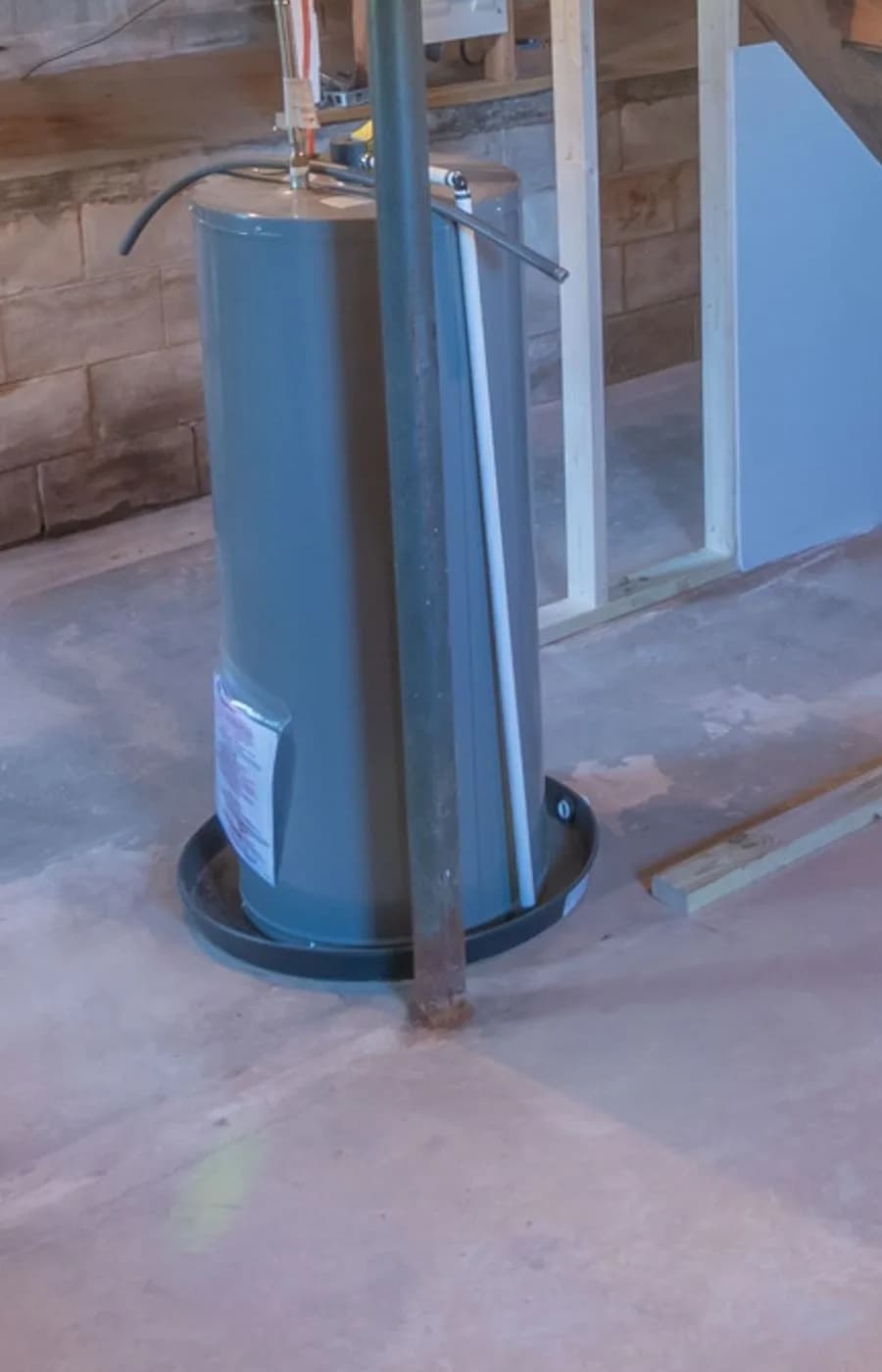
Shutting off a water heater
How you shut down a water heater depends on its fuel. In both cases, start by closing the cold-water supply valve on top of the tank (turn clockwise) so it stops filling.
- Gas water heater: turn the gas control valve on the front of the tank to the Off position. Don't shut off the gas line itself at the meter or in the basement unless you smell gas — that's a step for a technician or the utility, not routine shutdown.
- Electric water heater: switch off the water heater's breaker (often two slots for 240V units) at the electrical panel, then confirm no power at the unit before touching any wiring.
- If water is leaking from the tank body itself rather than a fitting or valve, the tank has failed structurally and needs replacement rather than repair.
- If standing water is anywhere near outlets, switches, or the panel itself, don't step in it — shut off power at the main breaker only if you can reach it from dry ground.
Frozen pipes: do's and don'ts
The Insurance Institute for Business & Home Safety (IBHS) frames winter pipe protection around one number: keep the thermostat no lower than 55°F, even in a house nobody's living in at the moment, because a heating failure is one of the fastest ways a home's plumbing goes from safe to at risk — especially during a power outage, when nothing is slowing the house down to outdoor temperature. IBHS also recommends insulating pipes in attics, crawl spaces, and along exterior walls before winter, since those are the locations that freeze first.
- Do shut off the water supply to the affected line before you do anything else, per IBHS's own guidance for a suspected frozen pipe.
- Do apply gentle, steady heat starting at the end nearest the faucet and working back toward the coldest section — a hair dryer, heating pad, or towels soaked in hot water all work.
- Do open the nearest faucet a trickle while thawing; it relieves pressure and tells you the moment water starts moving again.
- Don't use a blowtorch, propane torch, or other open flame on a pipe — it's a common cause of house fires during cold snaps.
- Don't leave an electric heating device unattended on or near a pipe, and never use one near standing water.
- If the pipe has already split, leave the main shutoff closed and call — reopening the water before the repair is made floods the house rather than just the one pipe.
- If you can't find where a pipe is frozen, or it runs behind a finished wall or ceiling, stop trying to thaw it yourself — trace it back from the nearest accessible section and call rather than opening up drywall to reach it.
Water damage timelines and documenting a claim
Once water gets into a floor, wall, or ceiling, the clock matters. The EPA's guidance on mold prevention states that wet building materials need to be dried within 24 to 48 hours to avoid mold growth — after that window, cleanup usually shifts from drying equipment to remediation, which costs more and takes longer.
FEMA's guidance on documenting property loss (published through Ready.gov) lays out the same short checklist adjusters look for on any claim, water damage included.
| Step | Why it matters |
|---|---|
| File the claim promptly | Many policies set a time limit on when a claim can be filed after the damage occurs |
| Take pictures and video before cleanup | This is your primary record of the damage and its extent for the adjuster |
| Save receipts | Keep receipts for construction and hardware supplies, plus any hotel or restaurant costs if you have to relocate temporarily |
| Work with your adjuster | Cooperating with the inspection visit helps the settlement move faster |
According to the Insurance Information Institute (cited in FEMA's property guide), standard homeowners policies generally do cover sudden damage from malfunctioning plumbing, heating, and air conditioning systems — but not flooding, which needs a separate flood policy. Check your specific policy for the deductible and any sump-pump or sewer-backup exclusions, which are common add-ons rather than standard coverage.
Emergency Plumber FAQs
Where is my main water shutoff?
Usually where the water line enters the basement — near the meter on a city supply, or beside the pressure tank on a well. Turn it clockwise until it stops. Find it before you need it; it is the first thing we will ask when you call.
A pipe froze but has not burst — what should I do?
Shut off the main, open the affected faucet, and warm the pipe gently with a hair dryer or warm towels — never a torch. If you see a split or a bulge, leave the water off and call; it will leak the moment it thaws.
Is a sewer backup an emergency?
Yes. Sewage in a basement is a health hazard and gets worse with every flush upstairs. Stop using water in the house and call. We clear the line and tell you whether the cause was a one-time clog, tree roots, or a broken pipe.
Do Not Wait — Call Now
The sooner you call, the less damage you face. J&R Mechanical Services handles heating and plumbing emergencies.
CALL (207) 902-8899More Ways We Can Help
Google ReviewsService Areas
9Find your town on our service area pages, starting with…
Company
5A few more places to begin include…
Services
30Explore the rest of what we do, from…
Not an Emergency? Request Service
Request Service
Fill out the form below to request an estimate or schedule service.
“*” indicates required fields
Need it today?Call (207) 902-8899